An AI receptionist for a small business is worth a pilot when one phone workflow has measurable missed-call opportunity, clear rules, and a human fallback. It is not automatically better than an IVR, voicemail, chatbot, or human answering service.
Start with overflow or after-hours intake, approved routine questions, permitted bookings, or callback capture. Do not use it for medical, legal, financial, safety, or emergency advice. The business must pause it, review uncertain calls, correct mistakes, and explain where caller data goes.
Key Takeaways
- An AI receptionist reads intent, retrieves approved information, captures details, takes bounded actions, and escalates with context.
- Start with overflow, after-hours intake, or supervised booking. Keep rules around calendars, permissions, fields, and escalation.
- Compare the simplest safe option. An IVR or voicemail may be better for a stable call tree; a human is stronger for empathy.
- Test with missed calls, qualified-call rate, booking or sale rate, contribution margin, service cost, and rework. An answered call is not revenue.
- Australian businesses should review AI disclosure, recording, retention, access, deletion, and overseas processing under OAIC guidance. This is not legal advice.
Default pilot mode: overflow or after-hours; capture first; no regulated advice; human fallback; pause and rollback ready.
What is an AI receptionist, and when does a small business need one?
An AI receptionist is a voice workflow. It receives a call, reads intent, asks approved questions, and takes a limited action. A tool call is a controlled request to another system. Examples include a calendar check or callback task. It should summarise the call and pass uncertain cases to a person.
The flow is simple:
- Take the call on the business number, a forward, or an overflow route.
- Learn why the caller rang. Ask only what that reason needs.
- Fetch an approved answer or a calendar result. Do not invent one.
- Complete a permitted action, such as a callback request or an allowed booking.
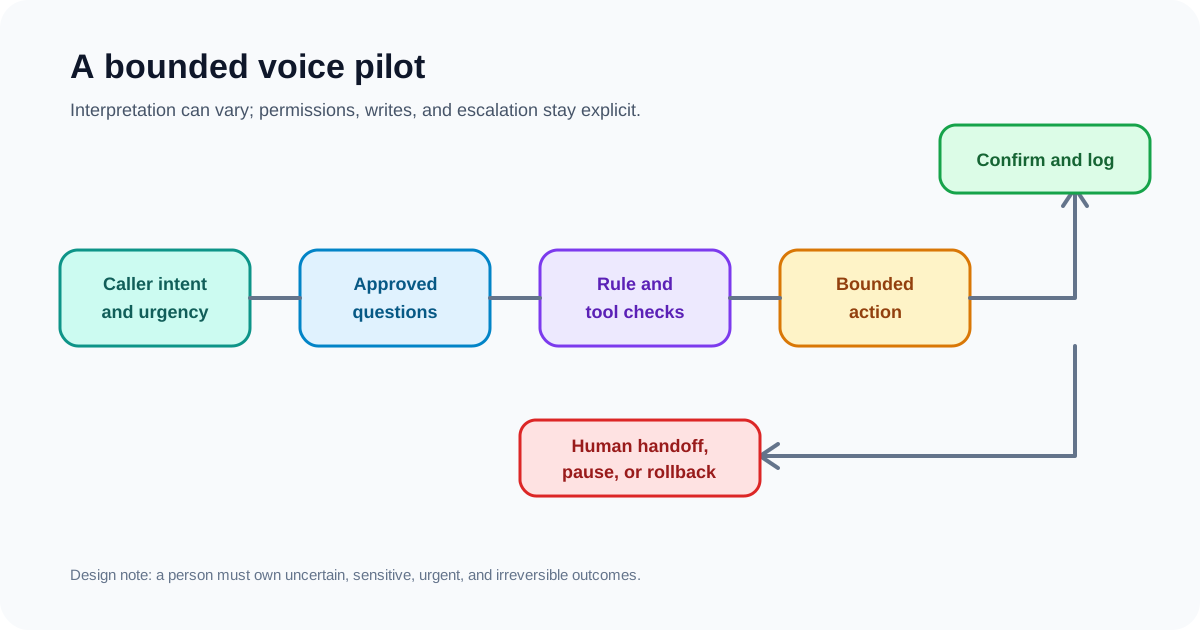
- Confirm the details, log the outcome, and pass exceptions on with context.
That is not a copilot, which assists a staff member. It is not an autonomous agent, which picks freely among next steps. A numbered menu is usually an IVR, even when an AI model sits behind one branch. Mislabeling every automated call flow sets the wrong expectation about control and risk.
For wider scope, see AI agent use cases for business. Here, test voice fit.
AI receptionist versus IVR, voicemail, chatbot, and human answering service
No option wins in every situation. Choose by caller channel, request variability, action needed, and the cost of a wrong answer.
| Option | Primary job | What it can safely do | Main boundary |
|---|---|---|---|
| IVR | Route through fixed menu choices | Deterministic routing and simple self-service | It does not interpret open-ended requests without additional capability |
| Voicemail | Record a message | Capture a callback request for later review | No live intake, booking, or immediate escalation |
| Web chatbot | Handle text questions on a site or messaging channel | Answer approved FAQs and capture a lead | It does not answer a normal phone call by itself |
| Human answering service | Apply human judgement to a live call | Show empathy, screen nuance, take messages, and forward urgent calls | Availability, cost, and system actions vary |
| AI receptionist | Interpret voice requests and act within rules | Intake, approved FAQs, calendar booking, summaries, and bounded transfer | Edge cases, stale information, sensitive calls, and tool failures need controls |
Use an IVR when callers pick from a stable menu. Use voicemail when volume is low and a callback works. A web chatbot is a text channel, not phone cover. Use a human service when callers need empathy, negotiation, or judgement.
An AI voice receptionist works best when wording varies but outcomes stay narrow. A hybrid is often strongest. Use IVR for routing, AI for bounded intake, and a person for distress, disputes, vulnerability, regulated advice, or doubt.
The best first use cases for a small-business voice pilot
The safest pilot is not “answer everything.” It is one call path with a small data set, a clear owner, and a known failure mode.
1. Missed-call and after-hours intake
The caller cannot reach the team. The receptionist captures the reason, name, callback number, service area, timing, and urgency. Required fields and read-back checks keep a fluent call from becoming a lost lead. Service-area rules, a callback queue, and a failure alert add safety. An owner or nominated person reviews urgent, unclear, or high-value requests.
Measure coverage, completed intake, correct callback, abandonment, and cost per completed intake. Watch for wrong numbers, repeated questions, and urgent calls stuck in a low-priority queue.
2. Appointment booking and rescheduling
Offer only allowed slots and create a booking in an approved calendar. Confirm the service and time, then send a summary. The calendar is the source of truth. Hours, service length, staff, timezone, duplicate checks, and confirmation should be fixed. A person handles unusual services, disputes, regulated visits, and conflicts.
Measure booking completion, reschedule accuracy, corrections or no-shows, and handoff. A booking with the wrong service, staff member, timezone, or duration is a failure.
3. Lead qualification and callback routing
A short, approved question set can capture need, timing, location, and service fit. It then routes or queues the enquiry. The receptionist must not invent a price, promise availability, or write a duplicate lead. Apply clear service-area and qualification rules. Send high-value, unusual, low-confidence, or sensitive enquiries to a person.
Measure qualified-intake rate, routing corrections, response time, and booked-consultation quality. Overconfident qualification hides doubt your team needs to resolve.
4. FAQ and status calls with a safe exit
Routine questions can use a small, current knowledge set. Always offer callback or transfer. Set a freshness owner, confidence limit, and ban on legal, medical, financial, and safety advice. A caller who disputes an answer or asks outside the source should reach a person.
Measure correct answers, repeat questions, transfer correctness, and human rework. A fluent but stale answer can cause harm. For orchestration, n8n use cases for small business covers it. This guide stays on voice intake.
Missed-call economics: how to test whether voice intake is worth it
“Pays for itself” is a business hypothesis, not a generic result. Set a baseline, use finance-approved values, estimate recoverable contribution, and subtract workflow cost.
| Input | How to measure it | Evidence status |
|---|---|---|
| Missed calls | Phone-system records for the baseline period, separated by business hours and after hours | Your measured data |
| Qualified-call rate | A reviewed sample that meets your qualification rule | Your measured data |
| Booking or sale rate | Bookings or sales attributable to qualified calls | Your measured data |
| Average contribution margin | Finance-approved margin, not top-line revenue | Business-specific source |
| Service, telephony, integration, and review cost | Provider quote plus internal exception and correction time | Verify at purchase |
The formula is simple. Estimated recoverable contribution equals missed calls, times qualified-call rate, times booking or sale rate, times average contribution margin. Then subtract service, telephony, set-up, monitoring, review, correction, and failed-booking costs. Invented inputs make an example hypothetical. They do not make it a forecast.
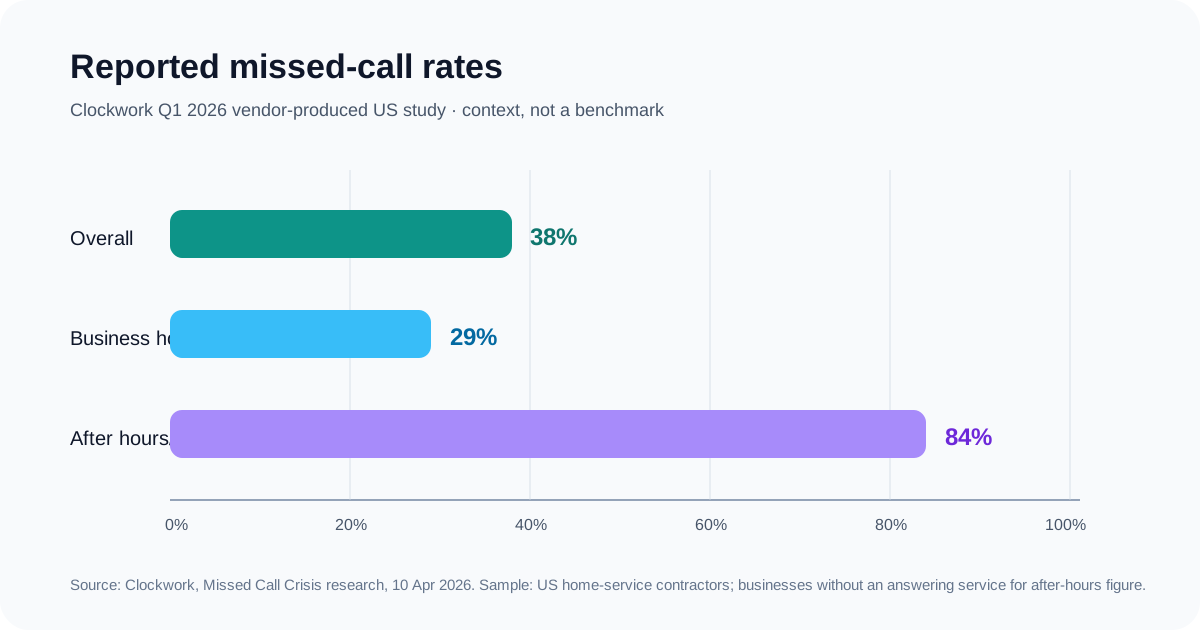
A directly reviewed Clockwork page reports a vendor-produced Q1 2026 study of 1,247 US home-service contractors and more than 2.4 million inbound calls. It defines “answered” as reaching a live human within 90 seconds. It reports 38% missed overall, 29% in business hours, and 84% after hours and weekends for businesses without an answering service (Clockwork missed-call research, published 10 April 2026). Those are reported figures from a US vendor study. They are not an Australian benchmark. Its annual-loss figure is a model, not measured loss.
Do not use the supplied CallRail PDF. It was not text-extractable, so its snippet figures stay unverified. This guide states no Praxon answer rate, price, result, or payback period.
For the wider value model, see AI agent ROI. Keep your own measurement on voice intake and completed calls.
Voice agent boundaries: booking, human handoff, privacy, and failure recovery
A production AI receptionist is mostly a boundary design. Use this list before live calls.
Booking and tool permissions
- Treat the calendar as the source of truth. Allow only approved operations: read availability, create a permitted booking, reschedule under policy, or create a callback task.
- Confirm caller name, phone number, service, date, time, and timezone before a write. Stop duplicate writes and alert on a failed tool or credential.
- Keep exact facts and irreversible actions in fixed rules. The voice model reads intent. It should not set policy or invent availability.
Human handoff
Transfer with caller context, not a blank warm transfer. Define destinations and response times for urgent, uncertain, angry, vulnerable, or regulated calls. If nobody is free, play a fallback message and create a callback. Measure handoff, context quality, abandonment, and human rework.
Privacy, recording, and the Australian data boundary
Tell callers when they are talking to AI and when calls are recorded or transcribed, subject to the laws that apply. Collect only what intake needs. Set retention and deletion rules. Limit transcript access and document provider training settings and subprocessors.
The OAIC’s guidance on commercially available AI products was published 21 October 2024 and updated 17 January 2025. It recommends explaining AI use, minimising personal information, and reviewing provider terms and data flows. It also calls for human review and correction (OAIC guidance). Australian Privacy Principle 8 (APP 8) concerns disclosure of personal information to an overseas recipient. Review provider data flows against the OAIC APP 8 guidance with a lawyer. Local hosting alone does not prove compliance. This is general technical information, not legal advice.
Provider policies show why this matters. Operator’s policy says calls may be recorded and transcribed, and it names telephony, AI, calendar, hosting, and database subprocessors. Some of those process data outside Australia (Operator privacy policy). Giday’s policy version 1.9, dated 3 September 2026, describes AI disclosure, a recording notice, retention and deletion, and US processing (Giday privacy policy). These are provider statements, not certifications.
Testing and recovery
Test interruptions, silence, accents, unclear requests, calendar conflicts, duplicate calls, stale knowledge, tool timeouts, angry callers, and emergency language. Start with capture and supervised booking. Keep a pause switch, audit record, and rollback path. Expand only when the owner can explain the failure modes.
When not to use an AI receptionist
Do not use one when call volume is too low to justify service, integration, monitoring, and review. Do not use it when callers need empathy, negotiation, or sensitive dispute handling that cannot be handed off fast.
A voice agent should not give legal, medical, financial, safety, eligibility, or emergency advice. It may capture and route within approved limits, but a qualified person must decide. Pause if the business cannot supply current hours, service areas, calendar rules, approved knowledge, or an escalation owner.
Do not proceed while recording, transcription, overseas processing, retention, access, or deletion terms are unclear. Choose an IVR, voicemail, web form, or fixed automation when the path is stable and those tools work better. A wrong booking, duplicate lead, or bad transfer must be detectable, fixable, and escalatable.
Use a voice agent for variable intake and bounded exceptions. Use fixed systems for policy, calendar writes, exact facts, and irreversible actions.
How to run a first pilot without overcommitting
Use a five-step sequence:
- Export a baseline for missed calls, after-hours calls, callbacks, bookings, and corrections.
- Select one narrow flow, preferably overflow or after-hours intake with no regulated advice.
- Configure a small knowledge set, allowed tools, required fields, transfer rules, and disclosure controls.
- Run supervised tests with real call variants. Review every failed or uncertain call.
- Compare coverage, completed intake, correct handoff, booking corrections, human rework, response time, failed tools, and cost per completed intake.
Expand only when the owner can describe the failure modes and rollback path. For platform rollout or governance, n8n for small business automation covers that separate decision.
Frequently asked questions
Is an AI receptionist better than a human answering service?
Not universally. AI can cover bounded, repetitive intake and scheduling. A human is better for empathy, negotiation, complex disputes, and sensitive calls. A hybrid often works best.
Can an AI receptionist book appointments?
It can connect to an approved calendar and work within hours, service length, staff, timezone, and booking rules. Require confirmation and a human route for conflicts or unusual requests. Check the provider’s current integration first.
Does an AI receptionist replace an IVR?
No. An IVR is fixed routing. An AI receptionist reads natural-language requests and can take bounded actions, but a fixed route may be cheaper and easier to predict. Many businesses can use both.
What should an AI receptionist do with an urgent call?
Follow an escalation rule, collect only needed information, transfer to a named destination or queue, and keep the context. It should not give emergency, medical, legal, financial, or safety advice.
How much does an AI receptionist cost?
Do not use a generic Praxon price or an unsupported market range. Compare setup, usage, telephony, integrations, monitoring, human exception work, correction cost, and data terms with the value of a completed intake.
Is overseas processing a privacy problem for an Australian business?
It can raise a cross-border disclosure question when personal information is accessible outside Australia. Review provider data flows and OAIC APP 8 guidance with a legal adviser. This is general technical information, not legal advice.
The bottom line: test the workflow, not the voice
The question is not whether an AI receptionist sounds human. It is whether one call workflow has measurable missed-call value, approved information, safe tools, a reliable person fallback, and a way to fix mistakes.
Document the baseline, first workflow, approval boundary, privacy controls, and success metric before you buy. For a scoped feasibility talk, see Praxon services and workflow automation services, then contact Praxon AI. No provider should promise a result before you measure your own call flow.
For how voice intake fits alongside other agent candidates, see AI agent development for business.
 Related posts